

HDPE & LDPE Polyethylene Sheets: Properties, Uses & Benefits
Light-weight, FDA grade, Natural and black are standard colors

HDPE sheet and LDPE Sheet
High Density Polyethylene (HDPE Sheet) and Low Density Polyethylene (LDPE) are both materials in the Polyolefin family of plastics, along with Polypropylene (PolyPro) and UHMW (Ultra High Molecular Weight).
Manufactured by a variety of manufacturers under several tradenames: Polyboard®, Polymar®, Hostalen®, Polystone®, Hitec® HDPE, Corrtec®, Sanalite®, UltraEthylux®, Polycarve®, and Densetec®.
For great abrasion resistance, very low density (lighter than water), and FDA/NSF compliance, HDPE sheets made from Polyethylene are an excellent choice.
Why use HDPE sheet/LDPE sheet for your application?
- Light Weight – Density between .941 and .965
- Stain, Odor, and Moisture Resistant
- FDA & NSF Approval for Food Contact
- Vacuum and Thermo-Formable Material
- Very Durable and Abrasion Resistant
- Self-lubricating and a low coefficient of friction
- Very High Chemical Resistance
- Low Specific Gravity (Floats in Water)
- Can be Heat Welded or RF Welded
- High Impact Strength and Energy Absorption
- Exceptional Low Temperature – Brittle at -110° F
- Does not chemically bond
- HDPE sheet/LDPE sheets are ITAR compliant, and HDPE sheet/LDPE sheet are RoHS compliant
Main Differences:
HDPE – Harder material, little to no flex, better tensile strength
LDPE – Softer, very flexible, lower tensile strength
Applications – HDPE:
- Cutting Board and Food Preparation Surfaces
- FDA, USDA, NSF Compliant Machined Parts
- Heat Formed and Vacuum Formed Parts
- Dasher Board For Ice Rinks – Impact Parts
- Welded Tanks, Hoppers, Silo Linings and Slide Chutes
- Chemical and Structural Tanks and Covers
- Food Processing Equipment, Valve, and Pump Components
Other applications include cement molds, body boards, transfer boards, death beds, mortician boards, cooler storage boards, spine board, tank liners, wear guides, and many, many more. HDPE sheet and rod are used in thousands of applications, from interiors of freezers, bed liners for trucks to personal protection gear.
HDPE sheet materials are available in stock in natural (milky white) and black. Other colors are available with minimum runs.
Applications – LDPE:
- Packaging Applications
- Industrial bags, produce bags, garment bags
- Blow Molded Bottles
- Toys
- Hot Melt Adhesives
- Wire Insulation
- Prosthetic appliances, Medical equipment, Semi-flexible tubing
Extruded Sheet:
.030 – 2.0″ in 48″ X 96″ Smooth Surfaces Natural in HDPE Sheet, 1″ max. for LDPE
Black available in many sizes of HDPE
Film:
.015″ – .060″ in 48″ wide Natural
Rod:
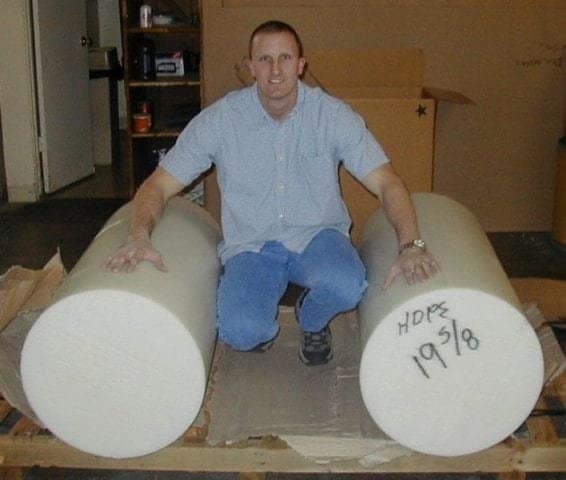
.250″ – 10″ diameter in Natural HDPE – 96″ lengths
From 12″ and up to 30″ diameter in 48″ lengths or 39″ lengths in HDPE
Black is available in many sizes of HDPE
Tube:
.250″ OD – 10″ OD in various wall thicknesses. Most available in HDPE and many in LDPE
Special Formulations:
Conductive, Static Dissipative, Custom sizes, Formulations, Profiles or Colors.
| General Property | ASTM Test |
Typical Value HDPE | Typical Value LDPE |
| Specific Gravity | D792 | .941 – .965 | .91 – .925 |
| Tensile Strength Yield | D638 | 3,800 – 5,500 | 1,400 – 2,000 |
| Izod Impact – Notched | D256 | 2.0 – 3.5 | >16 |
| Vicat Softening Temp | D1525 | 257 degrees F | 219 degrees F |
| Hardness – Rockwell | D785 | D60 -70 | D42 – 50 |
| Continuous Use Temp | – | -100 – 180 degrees F | 174 degrees F |
| Deflection Temp @ 66 psi | D648 | 171 | 124 |
| Co. Thermal Expansion | D696 | 7X10⁻⁵ | 4.6 -5.5X10⁻⁵ |

Playground HDPE sheet is UV stabilized for outdoor applications that is available in a variety of colors.
Sunboard and King StarBoard® are UV stabilized HDPE sheet materials for marine applications.
These properties are for evaluation purposes only. This information is not to be construed as a warranty, guarantee or assurance that you may achieve the same results. Materials made from different resin types, manufacturing techniques and manufacturers will react differently. The information should be used to compare against other materials only, and each user should make his own tests to determine suitability. No warranty as to this materials suitability are either expressed nor implied.