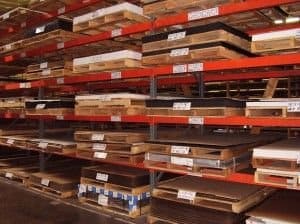
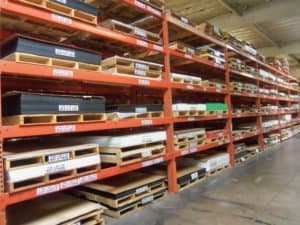
A wide variety of plastics are available in sheet form.
The term: ‘Plastic Sheet‘ or ‘Plastic Sheets’ is more of a general statement covering over a hundred types of plastic materials and plastic products. Some of the most popular plastic materials made as a sheet are:
In addition to the wide range of plastic materials available as plastic sheet, most of these materials are also available as: thin gauge or film, strip, plate, block, slab and plastic panels. The thin gauge or film materials are frequently available with or without a pressure sensitive adhesive also called ‘tape’. Sheet in some materials is available over 4.0″ thick and perhaps as thick as 8.0″ thick in a few materials. The standard sheet size on most of our plastic sheets is either 24″ X 48″ or the larger 48″ X 96″ sheet size; although some materials are available as: 48″ X 120″, 60″ X 96″ or 72″ X 96″. Contact us with with questions on your required piece sizes, we are happy to provide plastic sheets cut to size.
While there are lots and lots of different materials available as plastic sheet, there may only be one or two materials that are right for your application. We want to assist with your search. If you need help choosing the proper plastic material for your application, check out our free Plastic Material Selector Guide. Also, feel free to contact us for further assistance. As a leading plastic sheet distributor since 1975, we feel that we are your best choice as your new plastic sheet and sheets supplier. Give us a call at 866-832-9315.
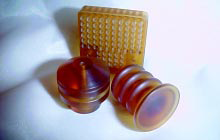
Polyetherimide or PEI is the generic name for one of the popular engineering resins. The most common resin supplier for this material is Sabic Plastics (formerly known at G.E. Plastics). This amorphous thermoplastic material comes in two common resin varieties used in the production of plastic shapes, the first is Ultem® 1000 which is an unfilled – natural material, the standard color for unfilled PEI (Ultem Sheet) is a transparent amber. The second is Ultem® 2300, which is a 30% glass filled PEI resin, this resin is a creamy tan color. Several other resins are available, including different percentages of glass fill, black pigment or color, and a few high end specialty grades. Some members our our industry refer to Ultem® as the ‘ultimate’ in plastic materials. With some of the best available properties, this material out performs most plastics in critical applications. This material is certified to: FDA compliance, USDA, 3A and also USP Class VI for medical use. Polyetherimides have exceptional tensile and flexural strengths and excellent electrical properties. Ultem® resins have inherent flame resistance and are UL 94 5VA at .075″. Ultem Sheet and rod machines very well, and can be used at temperatures of 340 degrees continuous.
Polyetherimide – PEI is the Ultimate Resin
The Polyetherimide family of plastic resins really excel in the medical and pharmaceutical industries. These industries have incredible demands on plastic materials, and most plastics fail quickly. Ultem resins handle the heat, chemical, stress better than almost any other material. For complete technical data sheets and more information chick for data sheet page. Several of our major manufacturers produce Ultem® PEI resins into stock sheets and rods. Some trade names from these suppliers are: Tempalux®, Sustatec®,Unitem®and many more. Ultem sheet and rod has some of the best properties of all the available plastic materials. Some materials that have some similar properties: Acetal, Radel, PEEK, PTFE. Check the data sheets on each of these materials to help in deciding which material is appropriate for your application.
Rod is normally available in rod from .375″ – 4.0″ diameters, and sheets from .125″ – over 2.0″ thickness, and we stock many items for immediate shipment. Additional sizes are available on request, including larger diameters, thicknesses, molded tube, extruded shapes, strips and bars.
Contact us for more details on this exceptional material. Email us or call us at 866-832-9315
Delrin® Homopolymer Acetal compared with Acetal Copolymer
Many of our clients assume that Delrin® rod and Acetal rod are the same thing. This is not true.
Yes, all TJC LP Delrin® (formerly Dupont Delrin®) rod is Homopolymer Acetal rod, but not all Acetal rod is Delrin® rod.
Delrin® is the trade name for Homopolymer Acetal made by TJC LP. TJC LP Delrin ® is a popular acetal homopolymer brand name and the most commonly used acetal homopolymer.
This is the most recognized of all trade names for Acetal materials, but not the only available Acetal material. The Copolymer Acetal resin is produced by a wide variety of large plastic manufacturers, BASF is probably one of the largest and most well known. Some main resin names are: BASF Ultraform® H4320, Kepital® F10-02, Hostaform® M25 and many others.
While Delrin® Homopolymer Acetal is a wonderful material, in a larger cross sections Homopolymer can exhibit center line porosity, or ‘soft centers’. This can sometimes be seen with the naked eye, and is a darker white in a normally milky white natural colored material. This center line porosity can cause problems in some applications. This porosity can cause leakage of fluid if under pressure, or soft center’s of homopolymer rod and sheet.
This should not stop you from considering Delrin® Homopolymer Acetal though. Many other properties of the homopolymer resins are superior to the copolymer resins. These properties are:
General Property
ASTM
Test
Typical Value
Unfilled
Homo-Polymer
Typical Value
Unfilled Co-Polymer
Specific Gravity
D792
1.42
1.40
Tensile Strength Yield
D638
9,600 – 11,000
9,000 – 10,200
Tensile Modulus
D638
450,000
400,000
Izod Impact – Notched
D256
1.2
1.0
Hardness – Rockwell
D785
M94
M90
Deflection Temp @ 264psi
D648
257
220
Deflection Temp @ 66 psi
D648
347
335
Water Absorption @ 24 hrs
%
0.24
0.25
Co. Thermal Expansion
D696
6.83X10⁻⁵
5.4X10⁻⁵
Some key properties for homopolymer acetal are: higher tensile strength, increased Izod impact, higher deflection temperatures and it is slightly harder. The co-efficient of thermal expansion is a bit higher, and needs to be considered when designing a new part. Extruded Delrin® brand homopolymer resin material also comes in several resin variations, including: Delrin® 150 and Delrin® 507, contact us for details. TJC LP Delrin® is a popular acetal homopolymer brand name and the most commonly used acetal homopolymer.
Many of our clients prefer the homopolymer rod and sheet for small machined parts. This is due to the increase in a few key properties, and of course brand recognition. Some of our major brand names for quality Copolymer Acetal (POM-C) sheet and Rod include: Tecaform AH®, Sustarin C®, ZL 900® and Pomalux®.
Both resins meet the standard ASTM-D-6778, and the cancelled specs, L-P-395 and ASTM-D-4181. Contact us for certification and specifications you may require.
The Acetal family of plastic resins are excellent for wear resistance, great mechanical strength, and superior machining properties. It is available in a huge range of sizes and shapes. Click here for more details on Acetal – Homopolymer Acetal Rod, and sometimes referred to as plastic dowel. We also have the capacity to supply colored Acetal Copolymer or Delrin® Homopolymer Acetal rod; click here from more details on the colored Acetal material.
Similar materials to Acetal Copolymer – Homopolymer Acetal are Nylon Rod, PET Rod and Noryl® Rod. Most materials are available as round rod, square rod, bar, strip, sheet and plate.
Please contact us for more details on these and other plastic materials. For a comparison chart of plastic materials click here: Plastic Materials Selection Guide
**Note: Delrin® is a registered Trademark of TJC LP
When we think of plastic, we think of plastic bags you get at the grocery store or maybe your child’s toy that’s made out of cheap throw away material. If you stop and think about it, plastic is everywhere and it’s uses are almost infinite. Take Acetal Copolymer, it is a plastic that replaces metal in numerous applications and is used to make gears, screws and other hard working parts. Consider PTFE for instance which is used to coat your frying pan to make it non-stick, make steam valves and fittings, and chemical resistant parts. Another material is Polycarbonate or Lexan® (a SABIC brand name -formerly G.E. Plastics) which is used to replace glass because it is shatter resistant and is also used for bullet resistant glazing and riot shields. Even the cup of coffee you grab for every morning is made of foamed Styrene – Styrofoam. But plastic has shaped our lives in countless ways, many of them you might not even think of or notice.
Plastics play a big part in the world of medicine. Some other advancements in the area of medicine include assisting people with debilitating injuries and serious afflictions, helping them feel more comfortable and move easier. Prosthetic limbs and joint replacements have come along way since the old days of metal and wood. Since the late 90’s UHMW or (Ultra High Molecular Weight Polyethylene) has become the standard in hip and joint replacements. With plastics like UHMW, which has great wear resistance, excellent strength and very low co-efficient of friction (very slippery), it has made people who need these surgeries have better mobility and better quality of life. These plastics also make prosthetic limbs lighter and stronger for athletes who wish to compete and lead near normal active lifestyles due to the use of plastic polymers (derived from the Greek meaning ‘many parts’) mimicking human flexibility. Prosthetic devices date all the way back to the ancient Egyptians where they used leather and wood for toe and foot replacements. But thanks to today’s technologies and advancements in as plastic, most amputees and athletes can regain their quality of life and enabling them to do what they love.
What has Medical Plastic Done For You Lately?
Another plastic material that has changed the medical field is PEEK (Polyetheretherketone). This material is a newer plastic which has high chemical resistance along with excellent high continuous temperature resistance of up to 480 degrees fahrenheit. PEEK has replaced many metal devices in the medical field, because PEEK is one of the only thermoplastics (plastic which can be bent or shaped) able to withstand high doses of radiation over an extended lifetime. In addition PEEK is used to help many people awaiting kidney transplants because it is used to make a critical component in dialysis machines. These machines need to clean the blood over a period of several hours and because of this, PEEK is the natural solution, as it can be steam cleaned time and time again with little effect on the material. Along with its great chemical, temperature, and fluid handling stability, PEEK is USP Class VI, making it ideal for these types of medical applications. The natural color of PEEK is a beige to tan and is available in sheet and rod. One of the largest manufacturers of PEEK resin is Victrex and their 450G resin.
Plastics In Medicine – Everyday
Plastic materials have become apart of our lives and has changed the way we take care of the sick and injured, how we protect our foods from germs, and prolong the storage of foods. Plastics protect medical instruments and insure they are sterile. It has made people’s lives better in both the short and long term. It has helped reduce pain, gain better movement and has given people their confidence back. The values of plastic can not be understated and in the future, hopefully plastics will save or prolong many more lives through advancements in technology and the limitless possibilities it presents.
For more information on these and other medical grade plastics like: Clear Nylon (look for blog post on this), Ultem, Polysulfone, Radel and more, contact us. E-mail us or call 866-832-9315
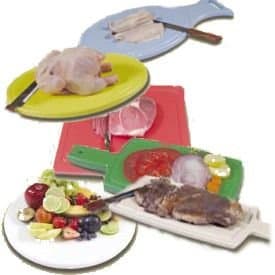
Next time you are cutting vegetables on your cutting board, the material most likely to be used is Polyethylene. Because it is stain, moisture and odor resistant, Polyethylene is a perfect choice. Other cutting boards made out of wood are more susceptible to bacteria and odors because they lack the properties that Polyethylene sheets offer, such as its chemical resistance and FDA approval for food contact. Polyethylene is a very durable and lightweight material that comes in many forms and is a great for a wide variety of applications.
NSF Approved Cutting Boards
The HDPE is available in .500″ thick in several FDA / NSF approved colors, and is great for use in kitchens where cross contamination is a problem.
The Ultimate Cutting Board
Polyethylene has many names. The most common are HDPE, LDPE, and UHMW. The difference has to with the molecular weight and branching which is when a monomer or atom is replaced by a longer chain of polymers (a long repeating chain of atoms). High Density is commonly used for milk jugs and food containers. Low Density is commonly used for bottles and plastic bags. UHMW, which has higher molecular weight (2-6 million) allows for an even transfer over the length of material which makes it stronger and able to be used for bearing applications due to its great wear resistance. Commonly used in the food and dairy industry, UHMW is a great replacement for other materials and solution to many problems. All of these polymers are derived from the same family but all have certain properties that make them a little different. HDPE provides great chemical resistance, with high impact strength and great energy absorption. LDPE has most of the same properties as High Density but is not as dense at 9.15, opposed to HDPE which is 9.34. It also has a lower tensile strength and easier formability.
UHMW is a strong material that has great durability and low co-efficient making it an ideal for sliding applications. Polyethylene offers a wide range of material choices and properties and has great durability that can be suitable for a number of applications. From the food industry to automotive, the kitchen or the warehouse, whatever your Polyethylene needs are; High Density, Low Density or UHMW, Polyethylene is a great choice.
Typical Resin Properties:
General Property
ASTM Test
Typical Value HDPE
Typical Value LDPE
Typical Value UHMW
Specific Gravity
D792
.941 – .965
.91 – .925
.93 – .94
Tensile Strength Yield
D638
3,800 – 5,500
1,400 – 2,000
6,800
Izod Impact – Notched
D256
2.0 – 3.5
>16
No Break
Vicat Softening Temp
D1525
257ºF
219ºF
260
Hardness – Rockwell
D785
D60 -70
D42 – 50
R64
Continuous Use Temp
–
-100 – 180ºF
174ºF
180ºF
Deflection Temp @ 66 psi
D648
171
124
174
Co. Thermal Expansion
D696
7X10⁻⁵
4.6 -5.5X10⁻⁵
11.0X10⁻⁵
Please contact us for more information on FDA and NSF approved plastic materials. Email us here, or call us at: 866-832-9315
Nylon Tube and Tubing can be made from Nylon 6 or 6/6
Nylon is one of the most popular and widely used plastic materials. From the carpet in your home to the yellow Nylon rope you have in your garage, Nylon is a tough and very wear resistant material. This self lubricating mechanical plastic material is very stiff and extremely durable. This material can be machined easily, and is a key industrial plastic resin.
Nylon 6 and Nylon 6/6 Tubing
While Nylon is a common plastic material, in the extrusion and cast grades, it is not a normal stock item for many factories. Nylon can be produced in a huge range of sizes. The cast process enables the range of sizes of a Cast Nylon Tube (Type 6) to be almost unlimited. The extrusion process is a bit more restrictive, which can produce very small sizes to larger sizes of Extruded Nylon Type 6/6 Tubing up to about 2.0″ OD. The properties of these materials are similar, and are listed here. Also, in the case of the Cast Type 6 Nylon Tube, many additives can be mixed into the casting mixture to increase many critical properties. Examples of these additives can yield: Glass Filled Nylon Tube, FDA Approved Oil Filled Cast Nylon Tubing, Cast Nylon MD Tube (molybdenum disulfide), Solid Lubricant Filled Cast Nylon Tube, and a few additional variations. These same filled items are also available in Cast Nylon Rod, Cast Nylon Sheets and Cast Nylon Plates (all made from the same Cast Nylon Type 6 resin). This casting process allows for a wide range of sizes and configurations, from round rod, cast sheet, tubular bar to near net shapes and covers on metal rollers and gears.
Why use Tubular Nylon (Nylon Tubular Bar)
There are numerous reasons to use a Nylon Tubular shaped material.1. Vast range of sizes to fit most requirements2. Large reduction of waste due to near net shape3. Great reduction of machining time due to matching size to finished needs4. Lower cost due to reduced material and reduced machining time
The difference between Nylon 6 Tubing and Nylon 6/6 Tube
The main differences are the base resin. The Nylon 6 tubing is a cast resin, and the Nylon 6/6 tube is an extrusion grade resin. Both materials are still Nylon, just a different grade of resin. The properties are also very similar, look here for specific Nylon resin properties. The other difference is that the Cast Type 6 Nylon is normally in larger sizes. This is because the cast version is poured as a liquid into molds or rigid tooling, and is done one at a time. This process, while it makes a very high quality part, is a more expensive manufacturing method, and is not cost effective in small or thin cross sections.The extrusion grade of Nylon, the Type 6/6 Nylon is heat processed in large batches. This process requires set up and large runs, and is very cost effective in these large production runs. In addition, the cross sections for the heat processed Nylon 6/6 can not be excessively large. The extruded Nylon 6/6 is therefor done sizes up to about 3″, as larger pieces are more expensive and require extra stress relieving to prevent warping.
Cast Nylon Versatility
The Cast Nylon manufacturing in the USA is very advanced. The production facilities can produce amazing and diverse sizes and shapes in the grades listed above. One of the unique versions of Cast Nylon is in the Glass Filled Nylon Tube, Glass Filled Nylon Rod and Glass Filled Nylon Sheet range. The percentage of glass fill can be custom blended to meet your specific needs, and can also contain additional fillers like MD, Oil or pigments. Many grades of Nylon are also available for very specific applications, like: bearings, sheaves, pulleys, wear plates, food processing applications, FDA approved grades, color matched for identification and many more. Other plastic materials used in these same applications include: Acetal Copolymer, PET (Polyester), PTFE and more.Contact us today for additional information on this or any other plastic sheet, rod or tube material. E-mail us here, or call us toll free at 866-832-9315, or visit our main web page at: iPlasticSupply.com