Acetal Copolymer and ABS (Acrylonitrile-Butadiene-Stryene) have some similar properties but are really very different materials. They similarities are: high impact strength, ease of machining with standard cutting tools and good mechanical properties. They are also both FDA compliant and are both good substitutes for brass. They also have great water absorption resistance and good electrical properties. Both materials are good for some of the same applications but certainly not all. Listed below are some of the major differences.
ABS Sheet and Rod Information
ABS comes as Natural (straw) and Black color in Plate, Slab, Sheets and Rods, and thin sheet (.040″ – .250″) it is available as White or Black with a textured surface one side. It can be cut from 48″ X 96″ sheets into strip, panels or pieces.
ABS is formable. ABS is a great thermo-formable material while Acetal is not. Acetal is used more for machined parts such as gears and screws. ABS is great for molding and shaping parts from vacuum to heat forming. Excellent for model building and prototype projects.
ABS is easily bondable (similar to PVC). ABS can be bonded or welded to itself. Because Acetal is self lubricating, it is not possible for anything to stick to it unless etching is done – therefor it is not bondable.
ABS is a great material for painting and silk screening. While Acetal can not be painted or silk screened unless it has undergone Corona Treating (a flame surface treatment), but if treated will nice paint or screened surface.
ABS has better chemical resistance than Acetals. Both are attacked by acids like sulfuric, but ABS has a wider range of resistance to chemicals like aqueous acids, alkaline and alcohol. Acetal will degrade when exposed to such chemicals as chlorine and alkaline.
Specialty grades of ABS are available, including: Glass Filled, Static Dissipating, and Fire Retardant Grades (like Royalite – R59)
ABS Typical Properties Table
General Property
ASTM Test
Value
Specific Gravity
D7921
1.08 – 1.25
Tensile Strength
Yield D638
4,100
Izod Impact – Notched
D256
7.7
Hardness – Rockwell
D785
R105
Deflection Temp @ 264psi
D648
177
Co. Thermal Expansion
D696
5.3X10-54.6 -5.5X10⁻⁵
Acetal Copolymer and Homopolymer Sheet and Rod Information
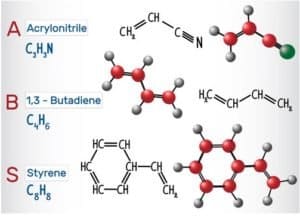
ABS Resin Structure
Acetal is the better machining plastic, considered the best machining plastic material. Because of its durability and wear resistance, Acetal is an excellent choice for producing a wide variety of parts that require high wear resistance over a wide period of time. When machining to tight and specific tolerances, Acetal is ideal.
Acetal has low co-efficient of friction. Due to its self lubricating properties, it is a great material for sliding and wear applications. This material provides years of maintenance free bushings and bearings.
Acetal sheet is produced from .062″ – over 6″ thick and sheet sizes of up to 48″ X 120″ as standard. The standard color for Acetal and Delrin is Natural (a deep milky white) and Black. Some colors are available as Medical Grade, and can be obtained in limited sizes. These sheet are available cut to: slabs, blocks, plates, slabs and blocks.
Acetal (Polyoxymethylene) can be both a homopolymer and a copolymer. The homopolymer acetal has a repeating chain of one atom while the Acetal copolymer has two atoms forming a repeating chain. Dupont™ Delrin® is a popular acetal homopolymer brand name and the most commonly used acetal homopolymer.
Acetal – Delrin Properties Table
General Property
ASTM Test
Typical Value Unfilled Homo-Polymer
Typical Value Unfilled Co-Polymer
Specific Gravity
D792
1.42
1.40
Tensile Strength Yield
D638
9,600 – 11,000
9,000 – 10,200
Tensile Modulus
D638
450,000
400,000
Izod Impact – Notched
D256
1.2
1.0
Hardness – Rockwell
D785
M94
M90
Deflection Temp @ 264psi
D648
257
220
Deflection Temp @ 66 psi
D648
347
335
Water Absorption @ 24 hrs
%
0.24
0.25
Co. Thermal Expansion
D696
6.83X10⁻⁵
5.4X10⁻⁵
ABS and Acetal Copolymer – Similar, but very different materials
Both of these materials possess excellent qualities and have a wide range of different uses. Acetal is great for machining, while ABS is great for forming and bonding. They both can be used for machined parts and are great choices for food contact and electrical applications. These two materials are both strong and durable plastics, but one might be better than the other for a specific job. When picking the right plastic, it is important to compare plastics and their specific properties to make sure the material won’t fail and that your job will be successful.
Contact us for additional information, call us at 866-832-9315 or contact us here. Consider Industrial Plastic Supply for all your plastic needs, we want to be your go-to plastic supplier.
**Note: Delrin® is a registered Trademark of Dupont
Some of our most popular questions are “Is this material UV stable”, or “How long will this last in direct sunlight”, or something similar. These are great questions. Just look at the ‘cheap’ backyard furniture you bought last year, yep, it is faded and cracking. Why is that?
The quick answer is the material had either no UV (Ultra Violet Light) stabilizer or very little. Most plastic materials are not UV stable to start with, other than Acrylic which is invisible to UV. All other materials need a little something to give it the protection it may need from the sun. Many plastic materials, if given the proper additives, can be used in direct sunlight for 10 – 15 years giving excellent performance.
The first factor in picking such a material is the intended use. Not all materials are good candidates for all applications.While some materials will perform very well, others under the same conditions will fail. Please contact us for details on a material to meet your needs. HDPE sheet is one of the best materials for long term outdoor use, if given the proper additives. Next time you drive by a children’s playground in your local city, look at the brightly colored panels used to make the play equipment. This is a HDPE sheet with heavy UV additives, and this makes an excellent application. Available in a rainbow of colors and able to be fabricated easily, this material is excellent for many outdoor applications. If your application is more mechanical, other materials that might be used would be: Polycarbonate, UHMW, ABS (especially with Korad cover), Acetal, Noryl and many more. Our standard Covestro Makrolon Polycarbonate is a UV stable material in sheet, and is frequently used in replacement glazing applications. The remaining materials on the list are available in Black (a carbon black pigment) which extends outdoor usage. While still not recommended for direct sunlight, they can be used with a good possibility of success – depending on design. Plastics can become brittle or lose properties over time if material does not have UV stabilization, with the proper material and the proper additives, you can get years of trouble free service.
Is Lexan® the same as Makrolon® or Tuffak® Polycarbonate?
The short answer is no, are they very similar, yes. The reason is that both Lexan® and Makrolon® are brand names, along with Hyzod®, Cyrolon®, Zelux®, Paltuf®, Tuffak®, Ensicar®, Unicar®, Texin®, Apex® and many more. Lexan® is a brand name for SABIC (Saudi Basic Industries Corporation) which acquired the entire General Electric Plastics division several years ago. Makrolon® (formerly Hyzod®) is a trade name for Covestro (formerly Bayer MaterialSciences).
These materials are all Polycarbonate which is a very tough, high impact plastic material. The base resins are very similar, however, the end product varies quite a bit depending on the manufacturer. The Covestro Bayer Makrolon® GP-V material does meet the UL 94 V-0 flame retardant certification (at .220″ thick), and the Makrolon® GP is UL 94 HB rated.
How do I tell the difference between Lexan® and Makrolon®?
It would be impossible to tell the difference between brands by just looking, unless it still has the masking on, it would take some testing. The majority of both brands of materials are available in a very clear, UV stabilized glazing grade and look identical to the naked eye. This material is excellent for replacing window glass and is virtually unbreakable.
Industrial Plastic Supply stocks the Covestro (Bayer) Makrolon® GP Polycarbonate materials in stock and ready for shipment. We have chosen to carry the Covestro Makrolon® Polycarbonate because of its superior quality, physical properties and ratings. You will find these materials available as sheet and rod here. If you have further questions, or would like to see the data sheet on Makrolon® Polycarbonate and/or Lexan® Polycarbonate for comparison, please give us a call: 866-832-9315 or email: request@indplastic.com
This post is part of our effort to answer as many questions for you as possible, and to assist you in choosing the proper material for your applications, this is another very popular question we hear.
Yes, Lexan® and Makrolon® are both Polycarbonate materials. And we believe that the Covestro Makrolon® is the best Polycarbonate sheet available in the market place.
Are Acetal Copolymer and Homopolymer Acetal the same?
This is one of our most common questions, and it is a bit involved of an answer.
There are two main versions of Acetal Resin
Homopolymer Acetal and Copolymer Acetal
The most popular name for a Homopolymer Acetal is the Dupont Delrin, which is a premium Homopolymer Acetal.
The second Acetal is a Copolymer acetal, and there are many suppliers of this resin.
Acetal is the generic, and not all Acetal is Delrin® Hompolymer, nor is it Acetal Copolymer. A distinction is required to determine which is best for your application. There are several manufacturers that produce Acetal Copolymer resin, including: Celanese®, BASF®, Ticona®, SABIC® and many more.
Acetal Copolymer compared to Delrin® Homopolymer Acetal
Delrin® is a premium homopolymer Acetal produced by Dupont. Many of the physical properties of the homopolymer exceed that of the copolymer Acetal. Dupont™ Delrin® is a popular acetal homopolymer brand name and the most commonly used acetal homopolymer.
The generic term ‘Acetal’ covers both the homopolymer from Dupont and the copolymer grades of resin. Both materials meet the ASTM-D-4181, ASTM-D-6100 or ASTM-D-6778 specification (an old call out is L-P-392). Homopolymer Acetal is POM111, and Copolymer Acetal is POM211.
Both are very tough and machinable, and have some similar properties.
An additional difference is the inherit problem of center-line porosity in some of the homopolymer grades. This is caused by out gassing during manufacturing, and can be found at the center or on the surface of all homo-polymer extrusions. This porosity can cause some problems with machining or moisture permeation through the material. The copolymer resin has little to no porosity issue.
Some of the other differences are in the physical properties of the resin. Review the chart for some of the most popular properties people ask for when looking at Acetal Copolymer or Homopolymer Acetal.
See Homopolymer and Copolymer Acetal properties chart below.
Properties
Homopolymer Acetal
Copolymer Acetal
Tensile Modulus of Elasticity
450,000
400,000
Flexural Modulus of Elasticity
470,000
366,000
Heat Deflection Temp @ 264 psi – degrees F
257
220
Melting Point – degrees F
347
335
Coef. of Linear Thermal Expansion
6.8 x 10⁻⁵
5.4 x 10⁻⁵
Water Absorption @ Saturation
0.90
0.80
Material is available as both Acetal Copolymer or Acetal Homopolymer in Rod, Block, Sheet and Slabs.
Acetal is one of the most widely available plastics, especially on the West Coast (for some reason the East Coast seems to like the Nylon – Polyamide material more). Most commonly available in Natural (White) or Black, but can be produced in a wide range of colors with minimum orders. This enables material matching your product color or for easy identification of parts.
While these properties are similar, depending on your application, one material may be better suited than the other. Review our Delrin® Homopolymer and Acetal Copolymer page for additional information on the product availability and data sheets. We get calls for the premium Delrin® Homopolymer product, but some people may call it Delron, Delran, Delrun, Derlin and many other names, but it is still premium Delrin® Homopolymer Acetal to us.
We have recently received a question from a client on an old product called Oilon PV80. This was one of the first attempts to make a plastic ‘slicker’, and they achieved this by adding an oil agent to Acetal resin. The Oilon PV 80 material failed miserably due to the oil additive not blending well with the base Acetal. The product had vastly uneven oil content throughout the extrusion. Don’t let this failure sway you away from Acetal products, as they are excellent machining and wear resistant materials, Acetal just doesn’t take the blending with oil. It does blend well with PTFE, and that is the very popular Delrin® AF (also known as LF13) product and this is a common replacement for the Oilon PV 80.
Since then, our factories have figured it out, and they now use Nylon as a base. The Nylon has made this a widely accepted success providing excellent performance and longevity. With a few different versions, this product line works extremely well in OEM, Manufacturing and many Food Processing applications. Check out this and other Nylon varieties on the Nylon page. Look in the upper right corner for the variety of material you are interested in.
Oilon PV80 vs. Nylon
Nylon provides the best of all worlds when it comes to filled wear resistant materials. It is a rigid material with natural wear resistance. In addition, Nylon can be cast with a variety of fillers and additives (ie. Oil, Glass, Pigments, Graphite, etc.) that extend and improve many properties – and they are equally dispersed through out the material. The Nylon is superior in this blending process, whereas the Oilon PV80 did not blend well at all. Cast Nylon also is available in a huge range of sizes and shapes.
Also, let us know if you want more info on the old, antiquated and abandoned materials of old. Most of those old materials have been replaced by superior performance materials. Some of the older call outs were just trade names, like Bakelite (the first high pressure laminate – phenolic sheet). Some members of our team remember the first materials invented, and of course all the materials that followed. Give us a try.
While Nylon has been a staple for many years, the casting process has been perfected and is made in huge range of sizes and grades. Take a step up to one of the newer high tech grades of Nylon. Most Cast Nylons can be produced with a variety of fillers to meet the demanding design requirements you need.
Choose a newer and superior material, and forget the old Oilon PV80.
**Note: Delrin® is a registered Trademark of Dupont