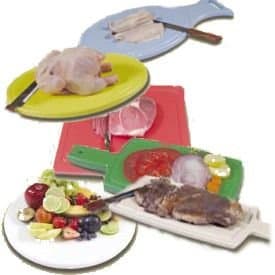
Next time you are cutting vegetables on your cutting board, the material most likely to be used is Polyethylene. Because it is stain, moisture and odor resistant, Polyethylene is a perfect choice. Other cutting boards made out of wood are more susceptible to bacteria and odors because they lack the properties that Polyethylene sheets offer, such as its chemical resistance and FDA approval for food contact. Polyethylene is a very durable and lightweight material that comes in many forms and is a great for a wide variety of applications.
NSF Approved Cutting Boards
The HDPE is available in .500″ thick in several FDA / NSF approved colors, and is great for use in kitchens where cross contamination is a problem.
The Ultimate Cutting Board
Polyethylene has many names. The most common are HDPE, LDPE, and UHMW. The difference has to with the molecular weight and branching which is when a monomer or atom is replaced by a longer chain of polymers (a long repeating chain of atoms). High Density is commonly used for milk jugs and food containers. Low Density is commonly used for bottles and plastic bags. UHMW, which has higher molecular weight (2-6 million) allows for an even transfer over the length of material which makes it stronger and able to be used for bearing applications due to its great wear resistance. Commonly used in the food and dairy industry, UHMW is a great replacement for other materials and solution to many problems. All of these polymers are derived from the same family but all have certain properties that make them a little different. HDPE provides great chemical resistance, with high impact strength and great energy absorption. LDPE has most of the same properties as High Density but is not as dense at 9.15, opposed to HDPE which is 9.34. It also has a lower tensile strength and easier formability.
UHMW is a strong material that has great durability and low co-efficient making it an ideal for sliding applications. Polyethylene offers a wide range of material choices and properties and has great durability that can be suitable for a number of applications. From the food industry to automotive, the kitchen or the warehouse, whatever your Polyethylene needs are; High Density, Low Density or UHMW, Polyethylene is a great choice.
Typical Resin Properties:
General Property
ASTM Test
Typical Value HDPE
Typical Value LDPE
Typical Value UHMW
Specific Gravity
D792
.941 – .965
.91 – .925
.93 – .94
Tensile Strength Yield
D638
3,800 – 5,500
1,400 – 2,000
6,800
Izod Impact – Notched
D256
2.0 – 3.5
>16
No Break
Vicat Softening Temp
D1525
257ºF
219ºF
260
Hardness – Rockwell
D785
D60 -70
D42 – 50
R64
Continuous Use Temp
–
-100 – 180ºF
174ºF
180ºF
Deflection Temp @ 66 psi
D648
171
124
174
Co. Thermal Expansion
D696
7X10⁻⁵
4.6 -5.5X10⁻⁵
11.0X10⁻⁵
Please contact us for more information on FDA and NSF approved plastic materials. Email us here, or call us at: 866-832-9315
Nylon Tube and Tubing can be made from Nylon 6 or 6/6
Nylon is one of the most popular and widely used plastic materials. From the carpet in your home to the yellow Nylon rope you have in your garage, Nylon is a tough and very wear resistant material. This self lubricating mechanical plastic material is very stiff and extremely durable. This material can be machined easily, and is a key industrial plastic resin.
Nylon 6 and Nylon 6/6 Tubing
While Nylon is a common plastic material, in the extrusion and cast grades, it is not a normal stock item for many factories. Nylon can be produced in a huge range of sizes. The cast process enables the range of sizes of a Cast Nylon Tube (Type 6) to be almost unlimited. The extrusion process is a bit more restrictive, which can produce very small sizes to larger sizes of Extruded Nylon Type 6/6 Tubing up to about 2.0″ OD. The properties of these materials are similar, and are listed here. Also, in the case of the Cast Type 6 Nylon Tube, many additives can be mixed into the casting mixture to increase many critical properties. Examples of these additives can yield: Glass Filled Nylon Tube, FDA Approved Oil Filled Cast Nylon Tubing, Cast Nylon MD Tube (molybdenum disulfide), Solid Lubricant Filled Cast Nylon Tube, and a few additional variations. These same filled items are also available in Cast Nylon Rod, Cast Nylon Sheets and Cast Nylon Plates (all made from the same Cast Nylon Type 6 resin). This casting process allows for a wide range of sizes and configurations, from round rod, cast sheet, tubular bar to near net shapes and covers on metal rollers and gears.
Why use Tubular Nylon (Nylon Tubular Bar)
There are numerous reasons to use a Nylon Tubular shaped material.1. Vast range of sizes to fit most requirements2. Large reduction of waste due to near net shape3. Great reduction of machining time due to matching size to finished needs4. Lower cost due to reduced material and reduced machining time
The difference between Nylon 6 Tubing and Nylon 6/6 Tube
The main differences are the base resin. The Nylon 6 tubing is a cast resin, and the Nylon 6/6 tube is an extrusion grade resin. Both materials are still Nylon, just a different grade of resin. The properties are also very similar, look here for specific Nylon resin properties. The other difference is that the Cast Type 6 Nylon is normally in larger sizes. This is because the cast version is poured as a liquid into molds or rigid tooling, and is done one at a time. This process, while it makes a very high quality part, is a more expensive manufacturing method, and is not cost effective in small or thin cross sections.The extrusion grade of Nylon, the Type 6/6 Nylon is heat processed in large batches. This process requires set up and large runs, and is very cost effective in these large production runs. In addition, the cross sections for the heat processed Nylon 6/6 can not be excessively large. The extruded Nylon 6/6 is therefor done sizes up to about 3″, as larger pieces are more expensive and require extra stress relieving to prevent warping.
Cast Nylon Versatility
The Cast Nylon manufacturing in the USA is very advanced. The production facilities can produce amazing and diverse sizes and shapes in the grades listed above. One of the unique versions of Cast Nylon is in the Glass Filled Nylon Tube, Glass Filled Nylon Rod and Glass Filled Nylon Sheet range. The percentage of glass fill can be custom blended to meet your specific needs, and can also contain additional fillers like MD, Oil or pigments. Many grades of Nylon are also available for very specific applications, like: bearings, sheaves, pulleys, wear plates, food processing applications, FDA approved grades, color matched for identification and many more. Other plastic materials used in these same applications include: Acetal Copolymer, PET (Polyester), PTFE and more.Contact us today for additional information on this or any other plastic sheet, rod or tube material. E-mail us here, or call us toll free at 866-832-9315, or visit our main web page at: iPlasticSupply.com
Gehr Plastics has been a major global manufacturer in the plastic sheet and rod industry since 1932. During this period, Gehr has become a leader in a variety of product lines, and also become known for very large sizes in both sheet and rod. Currently Gehr can produce Acetal rod up to 20″ in diameter and sheets up to 8″ thick. Some of the many plastic materials the Gehr produces:
Radel Rod is produced in many medical grade colors
Being innovative also means looking forward. Gehr was selected as the Bioplastics manufacturer of the year in 2008, partly for the new line of plastic materials which have a bio base. These materials have a variety of bio based forms, including: a PLA base, Cellulose based, Polyamide and Wood – Plastic Composite (WPC). One such material is ECOGEHR PLA-L which is a blend of polylactic (polylactic acid), some lignine, fatty acid and wax. This biopolymer is new to our industry and can be used in temperatures ranging from -22 °F to +140 °F.This complete line of materials is one of the only available in the plastic industry to be comprised of many renewable raw materials. Gehr leads the way in this exceptional and innovative product line.
ClearGehr Polyamide Rod
This brand new product is a Clear Polyamide rod. The outside surface is as extruded, and can be polished. This enables the production of a relatively clear sight glass quality material with most of the high end properties of Polyamide – Nylon material. We have supplied this material for small machined parts where neither Polycarbonate nor Acrylic would work well. Because of the natural inherit chemical resistance of Polyamide, this high end ClearGehr rod can out perform all normal transparent plastics. Give us a call to see if this new innovative product will work in your difficult application.
FDA Approved Wear Grade Acetal
Have you been looking for an extended wear Acetal material (like the PTFE filled Acetals – Delrin AF), but need it to be FDA approved? Then perhaps you should consider WearGehr. This proprietary filled Acetal material has excellent wear resistance, and retains the FDA approval of the base Acetal, unlike the PTFE filled Acetal materials which are not FDA approved. It is made in a blue color for easy identification, also it remains very machinable. Contact us for more information on this excellent high tech material.Call us at 866-832-9315 or send us a note here.
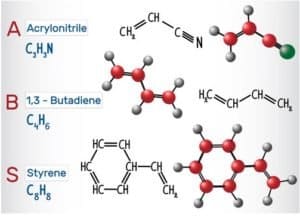
Acetal Copolymer and ABS (Acrylonitrile-Butadiene-Stryene) have some similar properties but are really very different materials. They similarities are: high impact strength, ease of machining with standard cutting tools and good mechanical properties. They are also both FDA compliant and are both good substitutes for brass. They also have great water absorption resistance and good electrical properties. Both materials are good for some of the same applications but certainly not all. Listed below are some of the major differences.
ABS Sheet and Rod Information
ABS comes as Natural (straw) and Black color in Plate, Slab, Sheets and Rods, and thin sheet (.040″ – .250″) it is available as White or Black with a textured surface one side. It can be cut from 48″ X 96″ sheets into strip, panels or pieces.
ABS is formable. ABS is a great thermo-formable material while Acetal is not. Acetal is used more for machined parts such as gears and screws. ABS is great for molding and shaping parts from vacuum to heat forming. Excellent for model building and prototype projects.
ABS is easily bondable (similar to PVC). ABS can be bonded or welded to itself. Because Acetal is self lubricating, it is not possible for anything to stick to it unless etching is done – therefor it is not bondable.
ABS is a great material for painting and silk screening. While Acetal can not be painted or silk screened unless it has undergone Corona Treating (a flame surface treatment), but if treated will nice paint or screened surface.
ABS has better chemical resistance than Acetals. Both are attacked by acids like sulfuric, but ABS has a wider range of resistance to chemicals like aqueous acids, alkaline and alcohol. Acetal will degrade when exposed to such chemicals as chlorine and alkaline.
Specialty grades of ABS are available, including: Glass Filled, Static Dissipating, and Fire Retardant Grades (like Royalite – R59)
ABS Typical Properties Table
General Property
ASTM Test
Value
Specific Gravity
D7921
1.08 – 1.25
Tensile Strength
Yield D638
4,100
Izod Impact – Notched
D256
7.7
Hardness – Rockwell
D785
R105
Deflection Temp @ 264psi
D648
177
Co. Thermal Expansion
D696
5.3X10-54.6 -5.5X10⁻⁵
Acetal Copolymer and Homopolymer Sheet and Rod Information
ABS Resin Structure
Acetal is the better machining plastic, considered the best machining plastic material. Because of its durability and wear resistance, Acetal is an excellent choice for producing a wide variety of parts that require high wear resistance over a wide period of time. When machining to tight and specific tolerances, Acetal is ideal.
Acetal has low co-efficient of friction. Due to its self lubricating properties, it is a great material for sliding and wear applications. This material provides years of maintenance free bushings and bearings.
Acetal sheet is produced from .062″ – over 6″ thick and sheet sizes of up to 48″ X 120″ as standard. The standard color for Acetal and Delrin is Natural (a deep milky white) and Black. Some colors are available as Medical Grade, and can be obtained in limited sizes. These sheet are available cut to: slabs, blocks, plates, slabs and blocks.
Acetal (Polyoxymethylene) can be both a homopolymer and a copolymer. The homopolymer acetal has a repeating chain of one atom while the Acetal copolymer has two atoms forming a repeating chain. Dupont™ Delrin® is a popular acetal homopolymer brand name and the most commonly used acetal homopolymer.
Acetal – Delrin Properties Table
General Property
ASTM Test
Typical Value Unfilled Homo-Polymer
Typical Value Unfilled Co-Polymer
Specific Gravity
D792
1.42
1.40
Tensile Strength Yield
D638
9,600 – 11,000
9,000 – 10,200
Tensile Modulus
D638
450,000
400,000
Izod Impact – Notched
D256
1.2
1.0
Hardness – Rockwell
D785
M94
M90
Deflection Temp @ 264psi
D648
257
220
Deflection Temp @ 66 psi
D648
347
335
Water Absorption @ 24 hrs
%
0.24
0.25
Co. Thermal Expansion
D696
6.83X10⁻⁵
5.4X10⁻⁵
ABS and Acetal Copolymer – Similar, but very different materials
Both of these materials possess excellent qualities and have a wide range of different uses. Acetal is great for machining, while ABS is great for forming and bonding. They both can be used for machined parts and are great choices for food contact and electrical applications. These two materials are both strong and durable plastics, but one might be better than the other for a specific job. When picking the right plastic, it is important to compare plastics and their specific properties to make sure the material won’t fail and that your job will be successful.
Contact us for additional information, call us at 866-832-9315 or contact us here. Consider Industrial Plastic Supply for all your plastic needs, we want to be your go-to plastic supplier.
**Note: Delrin® is a registered Trademark of Dupont
PTFE Rod is a remarkable product. PTFE – Polytetrafluoroethylene was discovered on April 6, 1938 by Dr. Roy Plunkett at the DuPont research laboratories. And this original PTFE was further developed by Dupont, and was released as a new product in 1945.
This product is extremely chemical resistant, and can handle temperatures above 500 degrees. One of the first household uses for PTFE is the ‘PTFE Coated Frying Pan’. While this pan works very well, it is a different process than the PTFE Rod and Sheet we supply. It is a sprayed on coating that is almost black in color, where the pure PTFE Rod and Sheet is bright white in color.
What are some of the uses for PTFE TFE Rod?
Because PTFE exhibits high temperature and chemical resistance, it is commonly used in valve applications. From simple steam / hot water valves to high heat, caustic chemical valves in the fluid handling industries. This material is a semi-rigid to rigid plastic, and can be machined very easily – one of the easiest plastics to work with. The PTFE rod can be machined to very close tolerance, and in most small diameter rod it is supplied with a +.002″/-.00″ on the diameter (check for tolerance on your requested size). The chemical resistance is one of the key properties associated with the material. In sheet or thin sheet (film) PTFE is used as gasket material for similar high heat and chemical resistant flange and seals.
PTFE Rod
Since 1945 Dupont has been the world leader in producing PTFE resins. Over the last couple of years, with the global shortage of Fluorspar (a key ingredient in producing all Fluoropolymer Plastics) Dupont has made some changes to their product offerings. Included in this change is a discontinuation of the production of one of most common granular molding powder (resin) used in the production of PTFE Rod and Sheet. This has the industry in a panic, the remaining global suppliers of PTFE resin are scrabbling to fill the void left by this decision. What does this mean to you? If you are used to purchasing PTFE rod or sheet, you may find the base materials may not be from Dupont. Our suppliers have small amounts of the Dupont resin, but mostly are replacing their raw materials with molding powder from other manufacturers. It may be, in the very near future, that all PTFE rod and PTFE sheet may not be made from Dupont brand resin.
Some of our clients have been using UHMW rod which is also a very slippery plastic material, but it does not take the high heat the PTFE rod does.
If you are one of the many clients that need this material, please contact us for clarification, information, supply chain news and possible changes in sources of supply. Call us at 866-832-9315 or email us here.


 contact. Polyethylene is a very durable and lightweight material that comes in many forms and is a great for a wide variety of applications.