People in the plastics industry have known for over 50 years that Tuffak Polycarbonate Sheets are tough. This clear plastic sheet material is commonly used to replace window glazing. The best known property for this polycarbonate sheet material is that it is break resistant, or in many cases, considered unbreakable. This is a great benefit for areas where window glass is broken easily.
Recently some cities have passed ordinances to change out the plywood window coverings on abandoned homes, and they are installing clear polycarbonate sheets instead. This is a very attractive replacement, and is a big step in fighting the blight of abandoned homes.
Polycarbonate is produced under several trade names, including Plaskolite Tuffak® GP, Covestro Makrolon®, SABIC Lexan®, Cyrolon®, Zelux® and many more. These materials are available in sheets, plate, slab, bar and rod.
Read more on this material below.
Excerpt from AZCentral, The Arizona Republic:
Property owners and banks in Phoenix had begun outfitting windows with sheets of polycarbonate, a thin, nearly indestructible plastic that mirrors the appearance of glass.
And last month, the city became among the first in the U.S. to make polycarbonate windows a matter of municipal law.
Phoenix now requires all window and door openings visible from the street to be secured with the material if the structure has been unoccupied for more than 90 days. The 90-day provision is also new, replacing the previous deadline of 180 days. The measures were the result of an abandoned buildings task force that Gallego spearheaded.
No one likes living next to abandoned buildings with boarded up doors or windows. So the city of Durham started replacing the plywood eyesores with a clear, durable plastic.
The city is working to reduce the number of abandoned houses by helping owners fix them up. But for houses that still need boarding up, the city has found that plastic not only improves the overall appearance of a neighborhood, it may reduce crime by discouraging squatters and making it easier for police to see inside vacant buildings.
“I can’t stress enough how the elimination of the boards has a tremendous positive impact on neighborhoods and communities,” said Faith Gardner, housing code administrator of the city’s department of neighborhood improvement services.
Read more here: https://www.newsobserver.com/news/local/counties/durham-county/article20778429.html#storylink=cpy
These communities have fought back against vandalism and crime, as well as enhanced the value of local homes by changing from Plywood to Clear Polycarbonate Sheets. Tuffak GP is a super tough glazing grade clear Polycarbonate Sheet material is the same kind of material that Police Officers use for face shields and banks are using for bullet resistant glazing.
The premier manufacturer of Polycarbonate Sheet in the USA is Tuffak® PG made by Plaskolite and made from Covestro® (formerly Bayer MaterialScience) resins, and they produce Tuffak® GP Polycarbonate Sheet. Polycarbonate is also available in rod and thick plate for machined parts.
Consider using Polycarbonate sheet for your next glazing material.
Why Do Performance Plastic Materials Get Unfairly Blamed?
Performance Plastic materials have been around for over a century now, and are used in almost every industry and application. The problem is that society has made the plastics industry the poster child for waste, trash and pollution. This is unfair, and factually incorrect.
Plastic materials are lighter, cost less to produce, use less electrical power to produce, and are safer for use. It is not new phenomenon that a material or product, once used, gets thrown away. This is the normal life cycle of many materials. Some inexpensive plastic materials used in consumer goods are made to throw away once the item has been purchased. Things like the indestructible packing we fight on kids toys, the cheap plastic ‘sporks’ from restaurants, the prolific plastic water bottles and of course, the plastic grocery bags. All of these materials are 100% recyclable, the hitch is that it requires a little effort to recycle.
Are Performance Plastic Materials The Cause?
On the positive side, the products that plastic currently replaces are much larger, heavier and generally cost more to produce, and use more energy to produce. This means, that the large amount of plastics that are not being properly disposed of, are replacing much larger quantities of materials that would not be recycled. I still remember times when I was a kid, and seeing tin cans in the lakes and rivers when out fishing. People polluting with their trash is not a new thing, now it is just a different group of materials.
Thermoplastic plastic materials are recyclable, and can be used over and over again. Generally, the recycled product would not be for a Food or Medical application. A common use of recycled plastic is with the collected milk jugs and detergent bottles, both made of HDPE, can be reground and turned into plastic lumber. The plastic lumber can be used to replace standard wood products for decks and outdoor furniture, and it will last for 15 – 20 years with no maintenance or painting. The cost savings and reduced use of natural resources for this one product can be staggering. The color doesn’t fade, it wood won’t split or crack, and it continues to look good for up to two decades.
Why Performance Plastic Materials Are Positive
Our recent article, “Plastic Material Bad Reputation – How did we get here?“, we discuss the factors that have lead to the ‘throw away’ society that we have become. Much of this bad reputation is for products that are designed as one use and then designed to be thrown away. So, if we are to change the bad reputation, companies need to change this design flaw, and start using materials for applications that can be reused easily.
If we can minimize the use of throw away plastics, and recycle the plastic material once we are done with it, we can help to limit plastic in land fills.
The blame for plastic pollution should be placed…on people. The plastic is not the cause of the problem, it is the litter-bug and irresponsible individuals that trash our planet. How do the plastic bottles and grocery bags end up in the ocean. They certainly don’t throw themselves in to the ocean, it is lack of responsibility and negligent behavior.
It really only takes a couple of seconds to throw something into a recycle bin. Even better would be to reuse the plastic bottles or plastic bags. Plastic materials are not the problem, empathetic people are the problem.
UHMW (Ultra High Molecular Weight Polyethylene) and PTFE Sheet(PolyTetraFlouroEthylene) are very similar materials, and yet very different at the same time. They both possess certain characteristics that make them similar to each other. For instance, they both have a very low co-efficient of friction, which means they are great for sliding applications and are easy to machine.
Both of these materials are very resistant to chemicals such as chlorine and some acids and have great wear resistance. They have low to no water absorption. Both materials are FDA approved for handling food. PTFE and UHMW Polyethylene are both nearly impossible to bond (without treatment) and are susceptible to sagging under tensile load which is called ‘creep’. These both have very low coefficient of friction and work well for wear strips, slide pads and truck liners to make it easy to empty. These two materials are different in many ways also, and choosing between the two materials for a specific job is critical.
Below are a few examples of how these two materials are different.
1. UHMW is a polyolefin and PTFE is a fluoropolymer. Polyolefins are double bonded carbon while Fluoropolymers are carbon and fluorine bonded. UHMW is a monomer which is consisted of one atom that will bond with another to form a polymer. PTFE is a polymer which is made up of a repeating chain of monomers.
2. PTFE has a higher temperature range than UHMW. The PTFE has a continuous use temperature of 500 degrees F. UHMW is much lower with a continuous use temperature of 200 degrees F and a melting point of 271 degrees F. The UHMW starts to become become soft at higher temperatures while the PTFE is much more resistant and with a melting point of 621 degrees F.
3. UHMW has higher abrasion resistance than PTFE. Both have great impact and wear resistance but because of UHMW having a molecular weight between 2-6 million making it the best wear resistance material in the plastic family, it makes it ideal to take wear and impact over a wider range and longer period of time without losing its properties.
4. UHMW has a much lower density than PTFE. This makes UHMW able to float in water while Fluoropolymers are significantly heavier (almost twice the density of UHMW) and would sink.
5. PTFE has excellent electrical and thermal properties. The virgin grade of PTFE is a better insulator and exhibits better electrical properties which can be used in radio frequencies, cables and circuit boards while UHMW cannot.
6. UHMW is much less expensive than the Fluoropolymers. Especially recently, PTFE has become harder to come by, and during the last 18 months there has been a global shortage of a key raw material called fluorspar that is used to make all Fluoropolymer materials. The ability to take lots of wear and tear and requiring low long term maintenance makes UHMW more cost effective.
7. The standard color of PTFE is Natural, which is a dense white. The UHMW comes in Natural (a deep milky white) or Black. The UHMW can be produced in many colors, and minimums are rather low. To obtain PTFE in colors is much more difficult, and would also have large minimum orders.
Click here for data sheet comparisons for each material…
Both the UHMW and the PTFE are available as sheet, sheets, sheeting, slab, bar, strip, panels, film, round rod, rods and block. Contact us for assistance with these or other shapes.
PTFE Sheeting Properties
Specific Gravity D792 2.14 – 2.24
Tensile Strength Yield D638 2,500 – 6,000
Tensile Modulus D638 80,000
Izod Impact – Notched D256 3.0
Hardness – Rockwell D785 D50 – D65
Deflection Temp @ 264psi D648 150
Deflection Temp @ 66 psi D648 250
Co. Thermal Expansion D696 5.5X10⁻⁵
UHMW Sheeting Properties
Specific Gravity D792 .93 – .94
Tensile Strength Yield D638 6,800
Coefficient of Friction – Static D1894 .25
Izod Impact – Notched D256 No Break
Hardness – Rockwell D785 R64
Vicat Softening Temp D1525 260
Deflection Temp @ 66 psi D648 174
Co. Thermal Expansion D696 11.0X10⁻⁵
These are just some examples of plastic materials being similar, and yet having very different properties. The PTFE Sheet and UHMW Sheet may appear very similar in color and can be used for some of the same applications, but when needed for a specific use or property needed, one might be dramatically better than the other. As the old saying goes, “You should never judge a book by its cover” and the same is true with plastic. Review the properties and test prior to choosing a final material for your application.
Call us for further assistance at 866-832-9315, or click here to contact us with your questions.
While you can purchase a piece of plastic from many different suppliers, there are some significant differences between these suppliers. Some of the main differences are in the manufacturers and the materials that you get supplied.
We see a wide range of materials and some drastically inferior grades of materials being sold to clients. Some materials have been produced too quickly or cooled too quickly causing a very high stressed plastic piece. These high stressed materials will warp, twist or crack when they get heated or during cutting. This material on the right is a piece of highly stressed Nylon. While cutting the material, our new customer had to stop the saw due to the severe warping and binding of the saw by this material. This new client brought this 24″ long part, and asked if we would cut it for him. We bought this part from him as an excellent example of a high stress plastic. (We did cut a quality piece of material to solve his problem).
One example of differences between manufacturers, is Gehr PVC rod is NSF 51 certified, while Simona PVC rod is not.
Other things you should consider when choosing a quality plastic supplier:
Quality of Materials
Origin of Materials
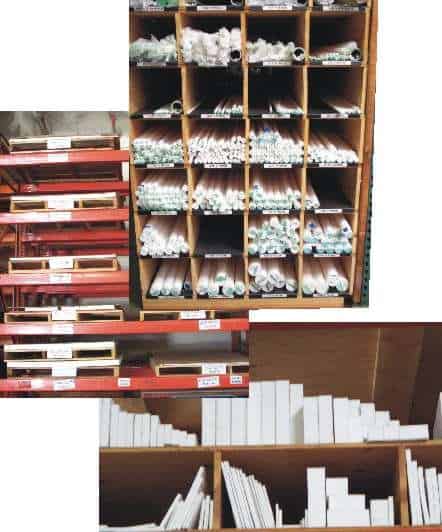
Huge In Stock Inventory of Plastic Rod
Expert Support
In Stock Materials
Cutting – Converting Services
Longevity – How Long Have They Been In Business (We started in 1975)
Product Knowledge and Experience Equals Quality Plastic Suppliers
We believe that providing quality products is only part of our duty to you. You have entrusted us to help with your requirements, and we believe we should be good stewards of this trust, all part of being a quality plastic supplier. A plastic sheet supplier should advise you if the material you are looking for is the ‘wrong’ material. Acrylic does not do well at 450 degrees. Styrene does not make a good chemical tank. HDPE and PTFE do not bond. These and many more ‘land mines’ are things we help our clients with everyday. We have an experienced client support team (plastic experts), and we value the opportunity to assist our clients with this experience. Go ahead, ask us a question – that is why we have a “Ask A Plasticologist” page on our website.
If you need help, from what are the properties of Acetal, to temperature range on Ultem, please contact us.We look forward to assisting you and all our clients. Feel free to contact us with any questions, concerns or requests – call us at 866-832-9315 or e-mail us here.
Polyvinyl chloride (PVC) has shown its versatility and durability for decades. Its use in piping, sprinkler systems, the construction industry and other areas has made it a popular commodity. The industrial-grade PVC sheet has numerous applications in the manufacturing area. Its low cost, workability, easy bonding, corrosion and weather resistance make it an all-round choice of industry.
PVC is Easy To Work With
Regardless of the application, working the PVC sheet is easy and cost-effective using simple tools that are common in other applications such as wood and steel. The chemical composition of the PVC sheet makes edging and machining simple and straightforward, and usually makes cooling unnecessary. However, when cooling is needed, compressed air, water or other liquids can quickly cool the material. Industrial PVC can be shaped and formed by:
Saws
Drills (Hand-held or drill presses)
Routers
Punch machines
Standard CNC Equipment
It is also easily sealed and bonded to itself or using common industrial adhesives. The easy working and bonding of PVC sheeting make it an excellent choice for use in manufacturing and industrial applications. Couple that with its relative low cost and ability to use common tooling methods and PVC is an indispensable choice, and can replace more expensive materials such as: ABS, Acetal, Nylon and many more.
Several PVC Grades Available
PVC is available in several grades. The most common is the Type 1 Gray PVC – the standard commercial grade PVC for machining, bonding and painting. CPVC (Chlorinated Polyvinyl Chloride) is also available, and sometimes called Corzan® or Lam 2000®, and is a higher continuous temperature resistant material. The CPVC is normally a blue tinted clear color, and is also available in a FM4910 approved grade.We also supply the Type 2 PVC which is used for improved impact strength applications. This Type 2 material is available in a White or Light Gray color.
PVC Sheet Comes In Standard Sizing
Storage and transport of PVC is also an advantage. Its 48″ x 96″ size makes it a uniform size with plywood and other building products. The range of thickness is: .062″ – 3″ thick and thicker. There is no need for special storage or handling equipment. Common storage areas that can store drywall, plywood or other standard building materials can easily store these sheets. Forklifts and existing conveyor systems never need retrofits to handle the PVC.
Durability
Finished products using PVC sheets are long-lasting. The material is highly impact resistant, durable in extreme temperature swings, weather and corrosion resistant. Its use for storage of corrosive chemicals in extreme conditions make it an indispensable material for chemical coatings and other storage containers.
Adaptable
The ease of bonding and shaping are just one of the best features of industrial PVC sheeting. It also accepts painting and screen printing. Materials such as wood, other plastics, fabrics and paper can be bonded to the surface to enhance the aesthetic value of whatever is created. Coatings such as vinyl or acrylic lacquers can be used to turn the object into attractive household items. Scratches or etchings on the surface of the raw material are easily removed using fine sanding and buffing equipment. The versatility of PVC in standard sheets makes this product an excellent choice for virtually any type of machining and manufacturing application. For more information on the impact and corrosion resistance properties of these sheets, visit: Industrial Plastic Supply for PVC Sheet. Find out about all the qualities that make using these standardized sheets an attractive choice for industrial use.For information on this or any other plastic sheet, slab, rod or tube product – call us at: 866-832-9315 or click here to send us a request.