While you can purchase a piece of plastic from many different suppliers, there are some significant differences between these suppliers. Some of the main differences are in the manufacturers and the materials that you get supplied.
We see a wide range of materials and some drastically inferior grades of materials being sold to clients. Some materials have been produced too quickly or cooled too quickly causing a very high stressed plastic piece. These high stressed materials will warp, twist or crack when they get heated or during cutting. This material on the right is a piece of highly stressed Nylon. While cutting the material, our new customer had to stop the saw due to the severe warping and binding of the saw by this material. This new client brought this 24″ long part, and asked if we would cut it for him. We bought this part from him as an excellent example of a high stress plastic. (We did cut a quality piece of material to solve his problem).
One example of differences between manufacturers, is Gehr PVC rod is NSF 51 certified, while Simona PVC rod is not.
Other things you should consider when choosing a quality plastic supplier:
Quality of Materials
Origin of Materials
Huge In Stock Inventory of Plastic Rod
Expert Support
In Stock Materials
Cutting – Converting Services
Longevity – How Long Have They Been In Business (We started in 1975)
Product Knowledge and Experience Equals Quality Plastic Suppliers
We believe that providing quality products is only part of our duty to you. You have entrusted us to help with your requirements, and we believe we should be good stewards of this trust, all part of being a quality plastic supplier. A plastic sheet supplier should advise you if the material you are looking for is the ‘wrong’ material. Acrylic does not do well at 450 degrees. Styrene does not make a good chemical tank. HDPE and PTFE do not bond. These and many more ‘land mines’ are things we help our clients with everyday. We have an experienced client support team (plastic experts), and we value the opportunity to assist our clients with this experience. Go ahead, ask us a question – that is why we have a “Ask A Plasticologist” page on our website.
If you need help, from what are the properties of Acetal, to temperature range on Ultem, please contact us.We look forward to assisting you and all our clients. Feel free to contact us with any questions, concerns or requests – call us at 866-832-9315 or e-mail us here.
Is HDPE Sheet and Acetal Homopolymer Sheet the same?
Here is another popular question asked by our clients. Is HDPE the same as Acetal Copolymer / Delrin Acetal Homopolymer? No, they are two totally different materials. Although the natural color of both is a milky white to opaque white, and they do look a bit similar, they are not. (HDPE is milky white to almost translucent depending on thickness, and the Acetal materials are a more opaque white to slightly milky – once again depending on thickness . See picture below of .500″ thick samples of HDPE and Acetal sheets)
HDPE and Acetal – Some Differences
The HDPE sheet and rod is a softer material, and is commonly known for its FDA certification and used in numerous food applications, such as: one gallon milk jugs, cutting boards, colored water glasses/cups, and many, many more. While it can be machined, because it is a bit softer and lighter, the tolerances it can be machined to are not very tight. It is not bondable, so it makes a great non-stick surface for sticky foods and adhesives.
The Acetal Copolymer and the premium Delrin® Acetal Homopolymer also have FDA certification, and are used heavily in the food processing industry. This material is a more mechanical material and is used in bearing and wear applications, cams, feeder screws, etc. This material is can be machined to tight tolerances, and will wear for long periods without lubrication. Due to its exceptional wear properties, it is not bondable, thus requiring mechanical fastening or threads to assemble. It has a very low water absorption, and you will find it in your toilet tank as the white moving parts in the filler mechanism. It is an extremely popular material for machinists, as it works much like soft brass.
While HDPE Sheet and Acetal Sheet look similar, they perform quite a bit differently.
While both materials are FDA approved, are machinable and can be used to make rigid wear resistant parts, they are two different resins and have drastically different physical properties. Another major difference is in the weight of these items, HDPE sheet and rod material weighs about 35% less than the Acetal sheet and rod material. Please check the data sheets for more information to assist in proper material selection.Acetal Data Sheet and HDPE Sheet Data
Acetal is commonly known as: Delrin Homopolymer Acetal, Tecaform AH,Ensital, Unital, Pomalux, Ultraform and many more.
HDPE is also known as: Ultraethylux,Densetec, Polystone G, Fortiflex, Versadur, Hostalen, and many more.
Contact us for more details on the HDPE and Acetal families of plastic materials, e-mail us or call 866-832-9315 Topic: HDPE sheet and Delrin Sheet (Acetal Sheet)
Polyvinyl chloride (PVC) has shown its versatility and durability for decades. Its use in piping, sprinkler systems, the construction industry and other areas has made it a popular commodity. The industrial-grade PVC sheet has numerous applications in the manufacturing area. Its low cost, workability, easy bonding, corrosion and weather resistance make it an all-round choice of industry.
PVC is Easy To Work With
Regardless of the application, working the PVC sheet is easy and cost-effective using simple tools that are common in other applications such as wood and steel. The chemical composition of the PVC sheet makes edging and machining simple and straightforward, and usually makes cooling unnecessary. However, when cooling is needed, compressed air, water or other liquids can quickly cool the material. Industrial PVC can be shaped and formed by:
Saws
Drills (Hand-held or drill presses)
Routers
Punch machines
Standard CNC Equipment
It is also easily sealed and bonded to itself or using common industrial adhesives. The easy working and bonding of PVC sheeting make it an excellent choice for use in manufacturing and industrial applications. Couple that with its relative low cost and ability to use common tooling methods and PVC is an indispensable choice, and can replace more expensive materials such as: ABS, Acetal, Nylon and many more.
Several PVC Grades Available
PVC is available in several grades. The most common is the Type 1 Gray PVC – the standard commercial grade PVC for machining, bonding and painting. CPVC (Chlorinated Polyvinyl Chloride) is also available, and sometimes called Corzan® or Lam 2000®, and is a higher continuous temperature resistant material. The CPVC is normally a blue tinted clear color, and is also available in a FM4910 approved grade.We also supply the Type 2 PVC which is used for improved impact strength applications. This Type 2 material is available in a White or Light Gray color.
PVC Sheet Comes In Standard Sizing
Storage and transport of PVC is also an advantage. Its 48″ x 96″ size makes it a uniform size with plywood and other building products. The range of thickness is: .062″ – 3″ thick and thicker. There is no need for special storage or handling equipment. Common storage areas that can store drywall, plywood or other standard building materials can easily store these sheets. Forklifts and existing conveyor systems never need retrofits to handle the PVC.
Durability
Finished products using PVC sheets are long-lasting. The material is highly impact resistant, durable in extreme temperature swings, weather and corrosion resistant. Its use for storage of corrosive chemicals in extreme conditions make it an indispensable material for chemical coatings and other storage containers.
Adaptable
The ease of bonding and shaping are just one of the best features of industrial PVC sheeting. It also accepts painting and screen printing. Materials such as wood, other plastics, fabrics and paper can be bonded to the surface to enhance the aesthetic value of whatever is created. Coatings such as vinyl or acrylic lacquers can be used to turn the object into attractive household items. Scratches or etchings on the surface of the raw material are easily removed using fine sanding and buffing equipment. The versatility of PVC in standard sheets makes this product an excellent choice for virtually any type of machining and manufacturing application. For more information on the impact and corrosion resistance properties of these sheets, visit: Industrial Plastic Supply for PVC Sheet. Find out about all the qualities that make using these standardized sheets an attractive choice for industrial use.For information on this or any other plastic sheet, slab, rod or tube product – call us at: 866-832-9315 or click here to send us a request.
A wide variety of plastics are available in sheet form.
The term: ‘Plastic Sheet‘ or ‘Plastic Sheets’ is more of a general statement covering over a hundred types of plastic materials and plastic products. Some of the most popular plastic materials made as a sheet are:
In addition to the wide range of plastic materials available as plastic sheet, most of these materials are also available as: thin gauge or film, strip, plate, block, slab and plastic panels. The thin gauge or film materials are frequently available with or without a pressure sensitive adhesive also called ‘tape’. Sheet in some materials is available over 4.0″ thick and perhaps as thick as 8.0″ thick in a few materials. The standard sheet size on most of our plastic sheets is either 24″ X 48″ or the larger 48″ X 96″ sheet size; although some materials are available as: 48″ X 120″, 60″ X 96″ or 72″ X 96″. Contact us with with questions on your required piece sizes, we are happy to provide plastic sheets cut to size.
While there are lots and lots of different materials available as plastic sheet, there may only be one or two materials that are right for your application. We want to assist with your search. If you need help choosing the proper plastic material for your application, check out our free Plastic Material Selector Guide. Also, feel free to contact us for further assistance. As a leading plastic sheet distributor since 1975, we feel that we are your best choice as your new plastic sheet and sheets supplier. Give us a call at 866-832-9315.
There are hundreds of plastic manufacturers, and even more plastic sheet, rod and tube suppliers.
What makes one better or worse than another? Some of the biggest differences are in the quality of the materials they have in stock. Not all manufacturers are the same. Some produce very inexpensive materials for the disposable trade. A few supply high quality materials from the big names in the plastic industry.
We buy only from American companies. Our suppliers and warehouses are all here, in the USA. While several of our factories have parent companies in Western Europe, they manufacture the bulk of their materials here in the states. With the NAFTA requirements, we are able to provide certification to all our materials.
American Made Quality Makes A Difference
As you probably know, materials made in areas around the world don’t have the same quality control systems that we have here. We have seen materials from suppliers not in the USA or Western Europe, and have chosen to not carry any of these materials – they just don’t measure up to Made In The USA! We believe that that American Made still means something, and it transfers to the materials we supply.
Since 1975 we have partnered with the best manufacturers, with the best industrial, machinable, mechanical and professional grades of plastic materials available in the marketplace. Quality names like: Westlake Plastics, Ensinger Plastics, Gehr Plastics, Roechling Plastics, Polymer Industries, Spartech Plastics, Z/L Plastics, Plaskolite, and many, many more. None of these are suppliers are newcomers, most of our suppliers have been in business producing excellent quality plastic sheet and rod for over 50 years. We are the new guys, as we started in 1975!
Buy From An Establish Plastics Professional
Industrial Plastic Supply of Anaheim California
How can you tell if your plastics are ‘quality’ pieces of plastic? It is a bit tough to tell by just looking, and that is what the low quality suppliers and manufacturers count on. Sometimes the only way to tell is by cutting or machining a part. We have cut into materials that literally break when a saw blade comes into contact. Some materials have stress levels so high they bow significantly as we cut through the material. See article on Stress In Plastics.
These high internal stresses show up during machining as warping, changes in tolerance, large movement in part size and stress fractures. We have seen parts move by over 5% after part was machined and within 12 hours. This picture shows a piece of glass filled nylon from one of the ‘upstarts’ in the industry. As a test, we were cutting some strips. As you can see, the part has such a high stress level that it warped away from the rest of the sheet as we cut it. This is very dangerous for a person cutting or machining, as it can stop a blade or break free and strike an employee. We chose not to buy from this new company.
Plastic Sheet and rods Proudly American Made
We have been around the block a few times, and we know most of the things that will cause you problems in a material. That is why we only buy from the big guys, the high quality material manufacturers, the well known – tried and true manufacturers. We buy from the experts, the professionals, the leaders in our plastics industry. Supplying industrial grade plastics to machine shops may seem like an easy thing. We treat this process with the respect it deserves; your parts are important to you and your customers. We won’t let you down by providing unacceptable grades of plastic materials. Our parts aren’t stressed out!
Call on us today – 866-832-9315 and ask for a Plasticologist, or email us for more information about the quality materials we supply.
You know how bad it is when you get stressed out, with all the day to day challenges and issues? Well, plastics get stressed too.
The process of producing plastics into sheet, rod and tube is a stressful manufacturing process.
Stress free plastic manufacturing
The process to make a plastic sheet, plastic rod or plastic tube requires the plastic resin to be heated to temperatures of 350° – 500º to get the resin to flow through the machines.
The material is then pushed through a die at high pressure.
This heat and pressure cause many stresses to affect the plastic material.
The cooling of the plastic shape is critical
If the plastic cools to quickly, the surface cools and the center is still very hot, this is a major cause of internal stress.
Processed to quickly and voids or cold spots cause poor quality sections.
Processed to slowly and materials burn in the die and visible burn spots appear on the surfaces – bad material
Proper speed provides homogeneous material that has cooled at a uniform rate through the sheet yields a very low stress sheet
The stresses from this production can be very significant and can ruin your parts. One common prevention method is to anneal or stress relieve the raw material prior to machining, and may require stress relieving during machining if large amounts of material are being removed. The stress relieving process is a slow heat and cool process, contact us for details on your material or project.
Here is an example of a highly stressed plastic sheet, it is 1.250″ thick glass filled nylon sheet. The manufacturer sent us this sample to show the ‘quality’ of their material. We attempted to cut off a strip to do some testing, and you can see the results. This material warped so much it stopped our saw! We never did buy anything from this supplier.
Compression Molded Plastic Sheet and Brownies…
Nylon with huge amount of stress, cooled too quickly.
Yes, you read that right, brownies. I still remember the wonderful smell of my Grandma’s house when she was baking her special 2″ thick brownies. The smell was great, but I also remember the critical timing in the oven. She would open the oven and peek in, and close it quickly so as not to let the heat out. Then, when they looked about right she would open the oven and slip a toothpick into the center of the pan and pull it out again slowly. I can remember asking, “Grandma, why do you put in the toothpick into the brownie?”. The answer was, that the outside cooks quicker than the inside, and it takes a while to get the brownies to cook all the way to the center.Then, when they were all cooked, I would have to wait while they cooled. And, sometimes, if I didn’t wait quite long enough, when I would take a bit the center would burn my tongue. Ouch!
The interesting thing is, that plastics are about the same. Most plastics have a very low co-efficient of thermal conductivity (that is sure a mouth-full), which means that heat and cold don’t travel through the plastics well. This means that it takes a while to ‘cook’ the plastic all the way through, and not just the surfaces. And, just like my brownie story, the plastics take a long time to cool. If the outside of the plastic cools much faster than the inside, then large amounts of stress develop.
The process of compression molding of the plastic sheets is ideal for eliminating stress. The sheets cook slowly, so the entire sheet, including the center, is heated to a uniform temperature. The temperature is held at temperature to insure a fully cooked sheet (you can’t use a toothpick here). Then, over several hours, the temperature of the sheet and the entire compression molding press is lowered very s-l-o-w-l-y. This allows the center of the sheet to cool at the same rate as the external surfaces, and this yields a very stress free sheet. The premier manufacturer of this high quality compression molded sheet is Westlake Plastics. We have been a master supplier of the Westlake Plastic materials for over 35 years.
What should you do to eliminate stress?
If you are experiencing problems with your plastic materials, such as twisting, warping, ‘potato chipping’ or any other sign of stress, contact us. It is probably not your fault. There are dozens of manufacturers that produce engineering and mechanical plastic shapes, they are not all the same. During the production of materials, the process should include a secondary annealing step to remove stress from the newly product. By removing all stress from the sheet or rod you are insured of a ‘clean slat’ before you start machining or finishing. We only provide materials from top rated manufacturers, we truly care about the materials you receive from us.
If you have been experiencing problems with the materials you are getting from other suppliers, let us know, we can help eliminate your stress problems. E-mail us or call us at: 866-832-9315
Polyetherimide or PEI is the generic name for one of the popular engineering resins. The most common resin supplier for this material is Sabic Plastics (formerly known at G.E. Plastics). This amorphous thermoplastic material comes in two common resin varieties used in the production of plastic shapes, the first is Ultem® 1000 which is an unfilled – natural material, the standard color for unfilled PEI (Ultem Sheet) is a transparent amber. The second is Ultem® 2300, which is a 30% glass filled PEI resin, this resin is a creamy tan color. Several other resins are available, including different percentages of glass fill, black pigment or color, and a few high end specialty grades. Some members our our industry refer to Ultem® as the ‘ultimate’ in plastic materials. With some of the best available properties, this material out performs most plastics in critical applications. This material is certified to: FDA compliance, USDA, 3A and also USP Class VI for medical use. Polyetherimides have exceptional tensile and flexural strengths and excellent electrical properties. Ultem® resins have inherent flame resistance and are UL 94 5VA at .075″. Ultem Sheet and rod machines very well, and can be used at temperatures of 340 degrees continuous.
Polyetherimide – PEI is the Ultimate Resin
The Polyetherimide family of plastic resins really excel in the medical and pharmaceutical industries. These industries have incredible demands on plastic materials, and most plastics fail quickly. Ultem resins handle the heat, chemical, stress better than almost any other material. For complete technical data sheets and more information chick for data sheet page. Several of our major manufacturers produce Ultem® PEI resins into stock sheets and rods. Some trade names from these suppliers are: Tempalux®, Sustatec®,Unitem®and many more. Ultem sheet and rod has some of the best properties of all the available plastic materials. Some materials that have some similar properties: Acetal, Radel, PEEK, PTFE. Check the data sheets on each of these materials to help in deciding which material is appropriate for your application.
Rod is normally available in rod from .375″ – 4.0″ diameters, and sheets from .125″ – over 2.0″ thickness, and we stock many items for immediate shipment. Additional sizes are available on request, including larger diameters, thicknesses, molded tube, extruded shapes, strips and bars.
Contact us for more details on this exceptional material. Email us or call us at 866-832-9315
Today’s topic is all about industrial plastic sheet materials in flat sheet or sheets. Also known as plate, slab, strip and bar.
Most plastic materials are processed into sheets or rods. Rods are round, sheet is flat, square or rectangular. These two basic shapes are both generally extruded, although sheet can also be compression molded. Almost all plastic raw materials are available in sheet, and in a huge range of sizes. Most materials are available from .063″ to over 4″ in thickness; and some as thick as 8″ (how to measure thickness accurately, use a 6-Inch Digital Caliper with Extra-Large LCD). Sheet sizes vary, but generally most plastics are produced in 48″ X 96″ sheets or larger, but once again this changes with types of materials and thickness desired. We can help with almost any plastic material.
Need Help Picking a Plastic Sheet Material?
Deciding on the proper material for an application is the first step. Start by reviewing our Plastic Materials Selection Guide to help narrow your search. Having the key properties and needs of your project in mind will help you with this step. Also looking at both the pro’s and con’s of a material will assist in this search. Materials with the greatest property range can be extremely expensive, selecting a material that meets your needs and your budget should be considered.
Step two is researching sizes and availability – this is where we can really help. With most of the major manufacturers as partners, we are able to source your parts from many factories. While the quality from most factories is excellent, the variable is standard and custom sheet sizes. We also stock a wide variety of materials in large sheets. One of our many manufacturers is Westlake Plastics. They have been compression molding large sized sheets of many popular plastic resins; these sheets are available in 48″ X 120″ as a standard sheet size in most plastics. They produce these materials from .250″ – 3.0″ thick or thicker. Other manufacturers produce 24″ X 48″ or 48″ X 96″ sheets as standard. Please contact us for specifics on your material selection.
Mechanical Acetal Sheet
Most of our plastic resins are available as a sheet. This includes some of the most popular plastics, like: Polycarbonate Sheet, Acetal Sheet, PTFE Sheet, Ultem Sheet and dozens more. Sometimes, Plastic sheet is called: Plate, Strip, Bar, Slab, Block or Panel. Please think of these names as being synonyms with Plastic Sheet. Contact us with your special requirements.
In thicker gauges, plastics are frequently referred to as plate, slab or block. And strips or narrow pieces are called bar. A rose by any other name, call it what you will, the plastic starts as a flat sheet from the factory. We can cut them to size or shape. Blanking of sheets to useable sizes is our specialty. Narrow pieces used for long applications are normally called strip. Strip is common in wear type applications.
For a list of materials we have as standard stock materials, check our Plastic Sheets Page. These and many other plastic materials are available, and custom sizes, shapes and colors vary by base material. As a stocking distributor for dozens of major manufactures, we are the West Coasts leading plastic sheet supplier or distributor. If you are in need of some technical assistance go to our Plasticologist page for specific help.
Contact us for more information on plastic sheet materials. Email us or call 866-832-9315
Delrin® Homopolymer Acetal compared with Acetal Copolymer
Many of our clients assume that Delrin® rod and Acetal rod are the same thing. This is not true.
Yes, all TJC LP Delrin® (formerly Dupont Delrin®) rod is Homopolymer Acetal rod, but not all Acetal rod is Delrin® rod.
Delrin® is the trade name for Homopolymer Acetal made by TJC LP. TJC LP Delrin ® is a popular acetal homopolymer brand name and the most commonly used acetal homopolymer.
This is the most recognized of all trade names for Acetal materials, but not the only available Acetal material. The Copolymer Acetal resin is produced by a wide variety of large plastic manufacturers, BASF is probably one of the largest and most well known. Some main resin names are: BASF Ultraform® H4320, Kepital® F10-02, Hostaform® M25 and many others.
While Delrin® Homopolymer Acetal is a wonderful material, in a larger cross sections Homopolymer can exhibit center line porosity, or ‘soft centers’. This can sometimes be seen with the naked eye, and is a darker white in a normally milky white natural colored material. This center line porosity can cause problems in some applications. This porosity can cause leakage of fluid if under pressure, or soft center’s of homopolymer rod and sheet.
This should not stop you from considering Delrin® Homopolymer Acetal though. Many other properties of the homopolymer resins are superior to the copolymer resins. These properties are:
General Property
ASTM
Test
Typical Value
Unfilled
Homo-Polymer
Typical Value
Unfilled Co-Polymer
Specific Gravity
D792
1.42
1.40
Tensile Strength Yield
D638
9,600 – 11,000
9,000 – 10,200
Tensile Modulus
D638
450,000
400,000
Izod Impact – Notched
D256
1.2
1.0
Hardness – Rockwell
D785
M94
M90
Deflection Temp @ 264psi
D648
257
220
Deflection Temp @ 66 psi
D648
347
335
Water Absorption @ 24 hrs
%
0.24
0.25
Co. Thermal Expansion
D696
6.83X10⁻⁵
5.4X10⁻⁵
Some key properties for homopolymer acetal are: higher tensile strength, increased Izod impact, higher deflection temperatures and it is slightly harder. The co-efficient of thermal expansion is a bit higher, and needs to be considered when designing a new part. Extruded Delrin® brand homopolymer resin material also comes in several resin variations, including: Delrin® 150 and Delrin® 507, contact us for details. TJC LP Delrin® is a popular acetal homopolymer brand name and the most commonly used acetal homopolymer.
Many of our clients prefer the homopolymer rod and sheet for small machined parts. This is due to the increase in a few key properties, and of course brand recognition. Some of our major brand names for quality Copolymer Acetal (POM-C) sheet and Rod include: Tecaform AH®, Sustarin C®, ZL 900® and Pomalux®.
Both resins meet the standard ASTM-D-6778, and the cancelled specs, L-P-395 and ASTM-D-4181. Contact us for certification and specifications you may require.
The Acetal family of plastic resins are excellent for wear resistance, great mechanical strength, and superior machining properties. It is available in a huge range of sizes and shapes. Click here for more details on Acetal – Homopolymer Acetal Rod, and sometimes referred to as plastic dowel. We also have the capacity to supply colored Acetal Copolymer or Delrin® Homopolymer Acetal rod; click here from more details on the colored Acetal material.
Similar materials to Acetal Copolymer – Homopolymer Acetal are Nylon Rod, PET Rod and Noryl® Rod. Most materials are available as round rod, square rod, bar, strip, sheet and plate.
Please contact us for more details on these and other plastic materials. For a comparison chart of plastic materials click here: Plastic Materials Selection Guide
**Note: Delrin® is a registered Trademark of TJC LP
Since 1975 we have provided large diameter plastic rods and thick plastic sheets, plates, slabs and blocks. One of our long time ‘secret’ sources has been Gehr Plastics. Since 1932 the Gehr family has owned and operated the Gehr Plastics company. They are a worldwide leader in semi-finished plastic shapes in thermoplastics, primarily sheet and rod. The headquarters for Gehr Plastics is in Mannheim, in south western Germany. For almost 30 years, Gehr Plastics has had production facilities in the Philadelphia area, providing the USA with the same high quality plastic shapes.When we mention large diameter rod, we mean it! Gehr can produce plastic rod up to almost 20″ diameter in several grades of plastic. They also produce sheet plastics up to 8″ thick, and make the largest materials of most manufacturers of plastic sheets and rods.
At Gehr Plastics, Quality Engineering Plastic Comes First
Our first purchases with Gehr Plastics was in the PVC rod family. Once again, they make huge cross sections in many materials, including the PVC rod. Many manufacturers struggle with large sections of PVC rod because keeping it void free throughout the large diameter is very difficult. Not for Gehr Plastics, they specialize in engineering plastic materials. We have chosen this high quality manufacture for their exceptional product quality. We know the demands of our client base, and only choose the best factories to supply our products. Gehr is definitely one of the premier plastics producers in the world. While the quality of the PVC rod is excellent, the rest of the Gehr Plastics product line is also some of the best plastic semi-finished shapes available in the market place. Here is a list of some of the many materials that Gehr Plastic produces:
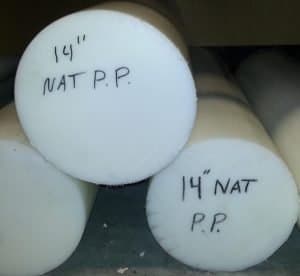
14 inch Natural Polypropylene Rod produced by Gehr Plastics, the largest domestic plastic rod currently in production. 12″ diameter UHMW rod from Roechling Plastics, Industrial Plastic Supply is master distributor for both of these manufacturers.
And a new and exciting product – Clear Nylon Rod (Contact us for more information)
Many of the above items are also available in sheets, plates, slabs or blocks.
Gehr Plastics – one of our engineering plastic partners
We have been proud to offer the complete line of plastic rod, sheet, slab, plate and block from Gehr Plastics, and consider them a highly valued partner in supplying these engineering plastic materials to you, our valued client. For more information on the size range, availability and pricing on these and other plastic materials,click hereor call us at 866-832-9315